

A lot of people equate leadership with “being in charge” or having a title. In reality, anyone can be a leader. It’s about recognizing that you are part of a team and understanding that team’s needs and interests. Here’s how you’ll do that with your troop!
As a Girl Scout volunteer, you’ll embark on your own leadership journey while you help Girl Scouts develop the leadership skills they’ll use to make the world a better place. Below are a few basic concepts that outline what leadership means in Girl Scouting.
Leadership is teaching your Girl Scouts:
As a leader, see yourself as a coach who:
It is important to remember that:
Your responsibilities as a Girl Scout volunteer include:
Contact info@gshnj.org to list your troop in the troop Opportunity Catalog. To locate additional marketing and recruitment materials, visit our Member Registration Assets page.
Choosing a Meeting Place
Meeting places should be welcoming to all. This could mean locations that serve diverse populations, are openly inclusive, have diverse staff, and use welcoming language. What makes a great meeting space depends on your troop, but look for spaces that are available and free to use, large enough for your troop activities, and equipped with resources that meet your needs. Also, make sure your space generally accommodates (is accessible to) individuals with physical disabilities who might attend meetings, including troop members and parents/caregivers.
Consider this as a starting point for a conversation with the contact of a potential meeting space:
“I’m a Girl Scout volunteer with a group of [number of members] Girl Scouts. We’re doing lots of great things for youth and for the community, like [something your group is doing] and [something else your troop is doing]. We’re all about leadership—the kind that Girl Scouts use in their daily lives and the kind that makes our community better. We’d love to hold our meetings here because [reason why you’d like to meet there].”
Can We Meet in a Private Home?
Girl Scouts does not recommend holding troop meetings in private homes, but if you’re considering doing so, check with your council to make sure council policy allows it. In addition to meeting the space needs outlined above, note that:
You must always obtain prior approval from your council.
The private home must be the home of a registered, council-approved volunteer.
Girl Scout members may not meet in a home where a registered sex offender resides.
Some councils require membership and background checks for all adults living in the home. Contact your council for specific guidelines.
Troop members need to be able to focus without disruptions from other household members.
Animals/household pets should be kept in a place that is separate from the meeting space.
Homeowners should consider any personal insurance implications. The homeowner should ask their personal homeowner’s insurance carrier if there are any insurance concerns with troop meetings in the home. Also, volunteers should confirm with the council that troop meetings in the home are covered by the council’s liability insurance carrier.
Any weapons must be out of view and in a locked space. Medications, cleaning products, and any poisonous substances must be stored in secure spaces, out of sight, and preferably locked.
Want more support? Contact your council or service unit support team for help securing a troop meeting place. You can also check out the gsLearn course Your First Troop Meeting.
The troop size “sweet spot” is large enough to support an interactive and cooperative learning environment and small enough to encourage individual development. Though the ideal troop size is 12 Girl Scouts, we recommend that group membership falls within the below ranges—no smaller than the low end, and no larger than the high end.
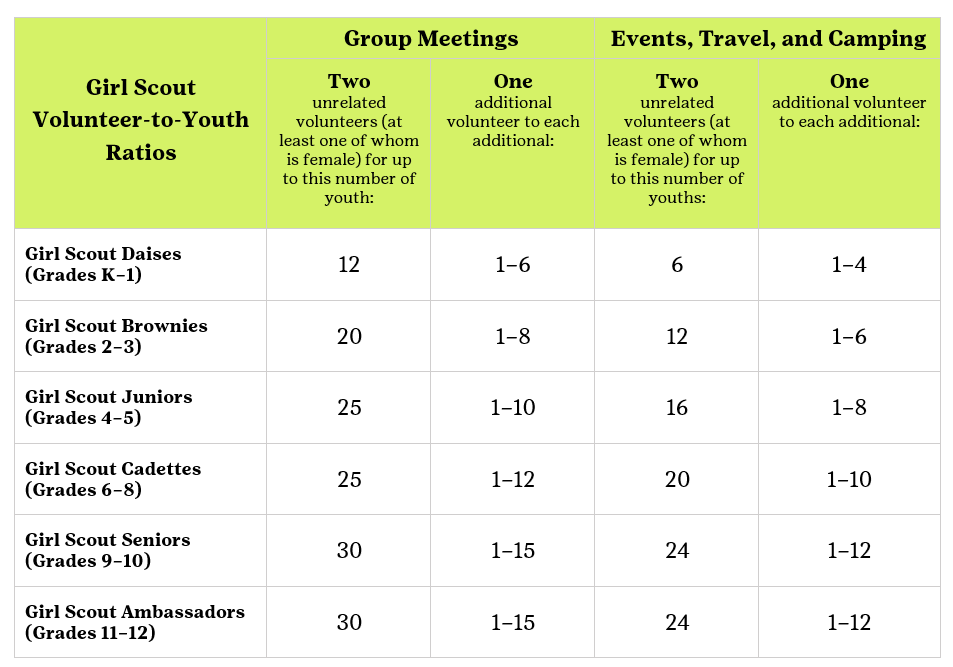
A Girl Scout troop/group must have a minimum of five Girl Scout youth and two approved adult volunteers. Be sure to double-check the volunteer-to-youth ratio table to make sure you have the right number of adults present for group meetings, events, travel, and camping.
Adults and youth registering in groups of fewer than five Girl Scout youth and two approved adult volunteers who are not related to each other or in a relationship, at least one of whom is female, will be registered as individual Girl Scouts to accurately reflect their status and program experience. Individual members are always welcome to participate in Girl Scout activities and events.
GSHNJ also offers live trainings that allow you to take your girls on wider experiences, such as:
Visit our website or contact training@gshnj.org for more information.
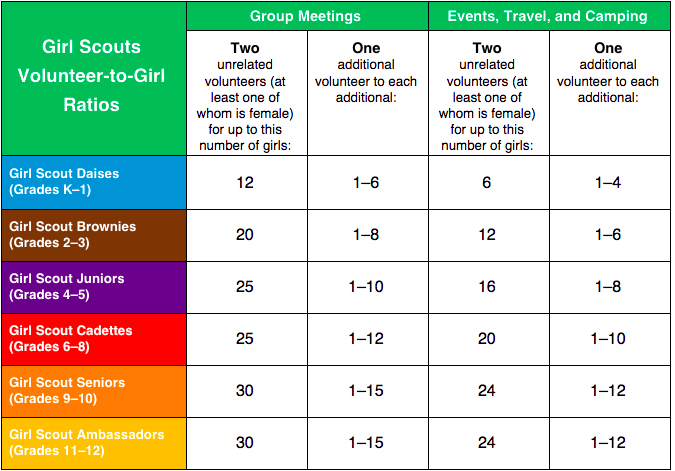
Girl Scout groups gathering in person or virtually must follow these guidelines:
Adult supervision rules apply to all Girl Scout activities, including meetings, trip/travel, camps, events, and activities. There are no exceptions. Report any deviation from this policy to your council.
Note: Invited or additional participating adults can be related, but they cannot replace the two unrelated leaders.
Determine the minimum number of adult chaperones needed:
Count all children (Girl Scouts or not) in supervision ratios unless they’re under the constant care of their own parent/guardian who is not acting as a chaperone.
|
Girl Scout Adult-to-Youth Ratios |
Group Meetings |
Events, Travel, & Camping |
||
|
Two |
One |
Two |
One |
|
|
Girl Scout Daises (Grades K–1) |
12 |
1–6 |
6 |
1–4 |
|
Girl Scout Brownies (Grades 2–3) |
20 |
1–8 |
12 |
1–6 |
|
Girl Scout Juniors (Grades 4–5) |
25 |
1–10 |
16 |
1–8 |
|
Girl Scout Cadettes (Grades 6–8) |
25 |
1–12 |
20 |
1–10 |
|
Girl Scout Seniors (Grades 9–10) |
30 |
1–15 |
24 |
1–12 |
|
Girl Scout Ambassadors (Grades 11–12) |
30 |
1–15 |
24 |
1–12 |
GSHNJ proudly honors our outstanding volunteers by celebrating their accomplishments and bestowing Adult Achievement Awards at our annual Volunteer Recognition Ceremony.
The emotional and physical safety and well-being of Girl Scouts is our top priority. Safety Activity Checkpoints outlines the Safety Standards and Guidelines used in Girl Scouting, which apply to all Girl Scout activities. Volunteers should refer to Safety Activity Checkpoints when planning Girl Scout-sanctioned activities.
In Safety Activity Checkpoints, you will find:
Safety Activity Checkpoints is laid out in three primary sections, Introduction: Safety Standards and Guidelines, Activities at a Glance, and Individual Safety Activity Checkpoint pages.
The Buddy System
Use the buddy system, in which the troop is divided into teams of at least two. Each Girl Scout is responsible for staying with their buddy at all times, warning their buddy of danger, giving their buddy immediate assistance if safe to do so, and seeking help if needed. They are encouraged to stay near the group or buddy with another team so if someone is injured, one person cares for the injured while others seek help.
Every participant (youth and adult) must register to become a member of Girl Scouts of the USA (GSUSA). GSUSA membership dues are valid for the Girl Scout membership year, which runs annually from October 1 through September 30. Membership dues cannot be transferred to another member and are not refundable.
Preregistration for the upcoming membership year occurs in the spring. Early registration allows for uninterrupted receipt of forms and materials from the council, helps troops and councils plan ahead, and gets members excited about all the great things they’ll do as Girl Scouts in the year to come. Note that a Girl Scout’s grade level is determined by the current membership year beginning October 1.
Lifetime membership is available to anyone who accepts the principles and beliefs of the Girl Scout Promise and Law, pays the one-time lifetime membership fee, and is at least 18 years old (or a high school graduate or equivalent). Volunteers with ten or more years of service can become lifetime members at the discounted young alum rate.
Adding New Girl Scouts to Your Troop
Growing your troop is a great way to share the power of the Girl Scout experience! There are many ways to get the word out, like hanging posters in local schools, using social media to reach families in your community, and including your troop in your council’s opportunity catalog or troop catalog.
For help registering your troop, contact your council’s customer care team.
Leaders may contact Girl Scouts Heart of New Jersey at info@gshnj.org to obtain recruitment flyers and helpful recruitment tips. You may also inquire about how to ensure your troop is displayed in the online Opportunity Catalog so prospective members can view your troop’s openings for youth and adult members.
Girl Scouts is for every girl, and that’s why we embrace Girl Scouts of all abilities and backgrounds with a specific and positive philosophy of inclusion that benefits everyone. Each Girl Scout—regardless of socioeconomic status, race, ethnicity, physical or cognitive ability, sexual orientation, primary language, or religion—is an equal and valued member of the group.
We believe inclusion is an approach and an attitude, rather than a set of guidelines. Inclusion is about cultivating environments that enable every Girl Scout to feel a sense of belonging. It’s about treating everyone with respect and dignity, and celebrating their unique strengths. It’s about being a sister to every Girl Scout. Some ways to cultivate inclusion and build belonging are to:
To learn more about this topic, check out our Delivering Inclusive Program training on gsLearn. If you have questions about accommodating an individual member, please reach out to your council.
Contact Girl Scouts Heart of New Jersey at info@gshnj.org.
Focus on Accessibility for All
A key part of creating an inclusive Girl Scout environment is making sure everyone is able to participate. As you think about where, when, and how often to meet with your group, consider the needs, resources, safety, and beliefs of all members and potential members. Seek to learn about the special needs of any members who have disabilities or whose parents/caregivers have disabilities—though don’t rely on visual cues to inform you. Disabilities include physical, sensory, and cognitive conditions, and not all of these are visible.
Approximately 20% of the U.S. population has a disability—that’s one in five people across every socioeconomic status, race, ethnicity, and religion. If you want to find out what an individual with a disability needs to make their Girl Scout experience successful, simply ask them or their parent/caregiver. If you’re open and receptive, they’ll likely respond in kind.
Remember, it’s important that all Girl Scouts be rewarded for their best efforts, not the completion of a task. Give everyone the opportunity to do their best, and they likely will! Sometimes that means changing a few rules or approaching an activity in a more creative way. Here are some examples of how to modify activities so that everyone can participate:
To learn more, take our Delivering Inclusive Program course on gsLearn.
Language Related to Disability
First and foremost, seek personal preferences. How would the Girl Scout or family member you're interacting with like you to refer to their disability (if at all)? When this information can't be determined or you’re speaking more generally, consider taking a person-first approach—acknowledging the person first, then the condition or disability, or what a person has, not what that person is. So not "schizophrenic person," but "person with schizophrenia."
Still, know that there’s considerable disagreement here, with many in the disability community preferring an identity-first approach (e.g., "disabled person," not "person with a disability"), which reinforces the importance of establishing and honoring personal preferences whenever possible.
When interacting with a person with a disability that you’re aware of, keep the following guidance in mind.
Speak directly to the person, not through a family member or friend.
It’s okay to offer assistance to an individual with a disability, but wait until your offer is accepted before you begin to help. Listen closely to any instructions the person may have.
Leaning on a person’s wheelchair is invading their space and should be avoided.
When speaking for more than a few minutes to an individual who uses a wheelchair, place yourself at their eye level.
When speaking to an individual who is deaf and using an interpreter, speak to them, not to the interpreter.
When greeting an individual with a visual disability, always identify yourself and others. You might say, “Hi, it’s Sheryl. Tara is on my right, and Chris is on my left.”
To learn more, take our Delivering Inclusive Program course on gsLearn.
Registering Members with Cognitive Disabilities
Girl Scouts with cognitive disabilities can be registered as closely as possible to their chronological ages. They should wear the uniform of the associated grade level. As a volunteer, you’re encouraged to make any adaptations to activities for Girl Scouts with cognitive disabilities.
These Girl Scouts may choose to retain their youth membership through their 21st year and then move into an adult membership category.
Remember, you’re never alone—your Girl Scout support team has your back! Just like Girl Scouts support each other, you’ll have a team of council staff and fellow volunteers ready to help you succeed. Here’s how to build your own troop support system:
From toolkits and guides to regular contact with experienced individuals, you’ll have all the support you need to be a Girl Scout volunteer. You can get such must-have tools as the Volunteer Toolkit (VTK) and gsLearn to keep your troop going strong on MyGS—always accessible via the icon on the upper right corner of our website. Click the login button and then my account button and you’ll find the gsLearn and VTK buttons via the left menu bar. They are accessible on any desktop, tablet, or mobile device, and it will be populated with any trainings you should view. Here’s a list of some important resources you’ll want to check out.
The Volunteer Toolkit is a customizable planning tool where you can find suggested meeting plans for most badges, access activity guides and badge requirements, track your Girl Scouts’ achievements, and so much more. With inspiring ideas so you can engage your troop in a mix of activities all year long, it’s the digital planning assistant that will help you power a fun-filled—and organized—Girl Scout year. Be sure to look for helpful icons to identify activity focus areas like the evergreen icon which tells you the activity can be taken outside or the globe icon which lets you know you can bring a global perspective to the activity.
With the Volunteer Toolkit, Girl Scouts and leaders can explore meeting topics and program activities together and follow the fun as they plan their Girl Scout year. Using the Volunteer Toolkit:
Troop Leaders can:
Parents and Caregivers can:
Get started by logging into www.gshnj.org .
Additional Tools and Resources
The Girl’s Guide to Girl Scouting. What does it mean to be a Girl Scout? You’ll find it all in The Girl’s Guide to Girl Scouting. These grade level-specific binders will break it down for your girls. It’s part handbook, part badge book, and 100 percent fun!
Safety Activity Checkpoints. Safety is paramount in Girl Scouting, and Safety Activity Checkpoints contains everything you need to know to help keep your girls safe during a variety of exciting activities outside of their regular Girl Scout troop meetings.
Tips for Troop Leaders. When you’re looking for real-world advice from fellow troop leaders who've been there, this volunteer-to-volunteer resource on the Girl Scouts of the USA website has what you need for a successful troop year.
Girl Scout Volunteers in Your Community. Remember that Girl Scout support team we mentioned? You’ll find them in your service unit! Troops are organized geographically into service units or communities. You’ll find a local network of fellow leaders and administrative volunteers ready to offer tips and advice to help you succeed in your volunteer role.
Customer Care Contacts. Questions? Need help resolving an issue? We’ve got you! Reach out anytime by either using our “Contact Us” form or email info@gshnj.org . During business hours you can reach a customer service specialist by calling (908) 518-4400.
Newsletters/Communication. We offer a monthly e-newsletter: Program Scout highlights upcoming program events for each age level and adults, too! Make sure you've opted in to receiving our emails on your MyGS account. Additionally, you can opt in to this monthly email by visiting the Subscription Center (linked at the bottom of any email you receive from Girl Scouts Heart of New Jersey) and clicking on each e-newsletter.
Tips for Troop Leaders. When you’re looking for real-world advice from fellow troop leaders who've been there, this volunteer-to-volunteer resource on the Girl Scouts of the USA website has what you need for a successful troop year.
Troop Year Plans. Our age-appropriate troop year plans are the best tool for first year troop leaders to get started with Girl Scouts without getting overwhelmed, or to help any troop leader with planning out a well-balanced Girl Scout year. The entire year is mapped out—just follow along to help your Girl Scouts complete badge activities, improve their communities, and explore the world around them. Access Troop Year Plans online here!
Girl Scout Volunteers in Your Community. Remember that Girl Scout support team we mentioned? You’ll find them in your service unit! Troops are organized geographically into service units or communities. You’ll find a local network of fellow leaders and administrative volunteers ready to offer tips and advice to help you succeed in your volunteer role.
Customer Care Contacts. Questions? Need help resolving an issue? We’ve got you! Reach out anytime by either clicking on the “Contact Us” form at www.gshnj.org or email info@gshnj.org. During business hours (Monday-Thursday 9:00 AM – 5:00 PM, Friday 9:00 AM – 2:00 PM) you can reach a customer service specialist by calling (908) 518-4400.
Newsletters/Communication.
Facebook
Instagram
Threads
LinkedIn
We know that when you have the knowledge and skills you need to manage your Girl Scouts, both you and your troop will thrive. We offer national onboarding training for new Troop Leaders in addition to local training courses provided by your council.
Girl Scouts Heart of New Jersey requires new troop leaders to complete the following trainings in gsLearn prior to meeting with Girl Scouts:
GSUSA Successful Leader Learning Series
This deep-dive “intro to Girl Scouts” gives new volunteers a better understanding of the Girl Scout Mission, the program pillars and outcomes, and general best practices for working with Girl Scouts.
GSHNJ Age Level Training - for your troop’s current age level(s)
Gain insight into your Girl Scouts’ unique age-appropriate abilities and needs, including tips for working with their age group.
GSHNJ Mandated Reporter Training
All GSHNJ volunteers and council staff are mandated reporters. Find out what this means, and what your responsibilities are, in this 20-minute training.
GSUSA New Leader Onboarding: What Girl Scouts Do
In this course, you will learn about what Girl Scouts do and how they do it at each grade level so you can plan your troop's year. This course is presented through the lens of an experienced troop leader whose troop completed all grade levels of the Girl Scout program. You will have the opportunity to explore the troop's interactive journal and learn about the things they did on their Girl Scout journey. Please note, you are only required to explore the grade levels you will be leading, although you are welcome to explore more if you'd like.
GSUSA New Leader Onboarding: Your First Troop Meeting
This course provides new troop leaders with the structure and tools to plan a successful first troop meeting—and beyond—with their Girl Scout troop.
GSUSA New Leader Onboarding: The Girl Scout Leadership Experience (GSLE)
The framework we use to grow future leaders, also known as the Girl Scout Leadership Experience, is what sets Girl Scouts apart from other organizations. In this course, you will learn how to facilitate the Girl Scout Leadership Experience with your troop in an age-appropriate way. Throughout the course, you will learn about lots of real-world examples so you can apply the framework as your troop ages through the Girl Scout program.
GSUSA New Leader Onboarding: Family Engagement: The Key To Success
Engaging families in their Girl Scout’s experience benefits troop leaders, Girl Scouts, and families too. This course illuminates the value of family engagement and provides practical strategies for how to enlist family support. It also equips you with an agenda to plan a parent/caregiver meeting to set the tone for family engagement for the year.
GSUSA New Leader Onboarding: The Girl Scout Cookie Program
In this course, you will learn the basics of the Girl Scout Cookie program. You’ll discover how and why Girl Scouts sell cookies, who the bakers are that make the cookies, and how to utilize your cookie proceeds with your troop. A review of all the exciting program options you can explore with your troop as you build their entrepreneurial skills is also included. Cookie selling safety and important ways to bring families and caregivers along in your troop’s cookie business adventure are also part of the course.
These courses are available online via gsLearn as referenced above. Your council may offer additional local onboarding training for new Troop Leaders, as well as other ongoing training opportunities. Contact your council to ask about additional training opportunities that will help you grow your skills and confidence.
Delivering Inclusive Program
In this course, you will practice using inclusive and equitable language to support the identities of all Girl Scouts and foster a cohesive troop environment.
Courses are also offered on specific badges including Daisy petals, Math In Nature, and Mental Wellness.
Outdoor and Overnights Training
Girl Scouts Heart of New Jersey offers a series of trainings for volunteers heading out with their troop on outdoor adventures.
Outdoors and Overnights Step 1 is self-guided online course available in gsLearn. The course covers the basics of outdoor safety and preparedness, and making sure your troop is ready for an outdoor event.
Outdoors and Overnights Steps 2 and 3 are in-person courses that teach basic outdoor skills such as tent building, knife safety, and outdoor cooking. Check our online events calendar for upcoming sessions.
First Aid and CPR Training
Any time you leave your regular troop meeting location, you must have an adult certified in both First Aid and CPR present. Certification trainings are offered through council; you can also find trainings through American Heart Association and American Red Cross. Trainings conducted entirely online are not acceptable. Blended trainings are acceptable provided the skills testing portion of the course is conducted in-person, and under the guidance of a certified instructor.
Required New Leader Onboarding Courses
Girl Scouts Heart of New Jersey requires new troop leaders to complete the following trainings in gsLearn prior to meeting with Girl Scouts:
New Leader Fundamentals
Learn the basics of delivering the Girl Scout Leadership Experience in this 110-minute course.
GSHNJ Age Level Training - for your troop’s current age level(s)
This 10-minute course reviews your Girl Scouts’ unique age-appropriate abilities and needs, including tips for working with their age group. This course must be taken each time your troop ages up.
Child Abuse and Neglect Prevention Course
This 50-minute training prepares adults to recognize, respond to, and report concerns of child abuse and neglect.
GSUSA New Leader Onboarding: The Girl Scout Cookie Program
In this 20-minute course, you will learn the basics of the Girl Scout Cookie program. You’ll discover how and why Girl Scouts sell cookies, who the bakers are that make the cookies, and how to utilize your cookie proceeds with your troop. A review of all the exciting program options you can explore with your troop as you build their entrepreneurial skills is also included. Cookie selling safety and important ways to bring families and caregivers along in your troop’s cookie business adventure are also part of the course.
Delivering Inclusive Program
In this course, you will practice using inclusive and equitable language to support the identities of all Girl Scouts and foster a cohesive troop environment.
Outdoor and Overnights Training
Girl Scouts Heart of New Jersey offers a series of trainings for volunteers heading out with their troop on outdoor adventures.
Outdoors and Overnights Step 1 is self-guided online course available in gsLearn. The course covers the basics of outdoor safety and preparedness, and making sure your troop is ready for an outdoor event.
Outdoors and Overnights Steps 2 and 3 are in-person courses that teach basic outdoor skills such as tent building, knife safety, and outdoor cooking. Check our online events calendar for upcoming sessions.
First Aid and CPR Training
Any time you leave your regular troop meeting location, you must have an adult certified in both First Aid and CPR present. Certification trainings are offered through council; you can also find trainings through American Heart Association and American Red Cross. Trainings conducted entirely online are not acceptable. Blended trainings are acceptable provided the skills testing portion of the course is conducted in-person, and under the guidance of a certified instructor.
Questions about training? Contact training@gshnj.org.
© Copyright 2009–2026 Girl Scouts of the United States of America. All rights reserved. All information and material contained in Girl Scouts’ Volunteer Essentials guide (“Material”) is provided by Girl Scouts of the United States of America (GSUSA) and is intended to be educational material solely to be used by Girl Scout volunteers and council staff. Reproduction, distribution, compiling, or creating derivative works of any portion of the Material or any use other than noncommercial uses as permitted by copyright law is prohibited, unless explicit, prior authorization by GSUSA in writing was granted. GSUSA reserves its exclusive right in its sole discretion to alter, limit, or discontinue the Material at any time without notice.